

Best Eye Drops for Sensitive Eyes (2026): What to Use and What to Avoid
Key takeaway: If your eyes sting, turn red, or feel worse after using eye drops, your drops are probably the problem — not your eyes. Most over-the-counter eye drops contain preservatives and other ingredients that trigger reactions in sensitive eyes. Redness relief drops are the worst offenders, causing rebound redness and long-term damage. Below we compare the best eye drops for sensitive eyes in 2026 and explain exactly what to avoid. The Peep Club Instant Relief Eye Spray is the only product on this list that’s preservative-free, easy to apply (spray format), and formulated with ingredients that also nourish the delicate skin around the eyes.
Sensitive eyes are not rare. Millions of people experience stinging, burning, watering, or redness every time they try to use eye drops — and most assume it’s just something they have to live with. It isn’t. In the vast majority of cases, the reaction is caused by ingredients in the drops themselves, not by an inherent problem with the eyes.
Preservatives like benzalkonium chloride (BAK) are the most well-documented culprits, but they are far from the only ones. Fragrances, redness-relief agents, and menthol all have the potential to irritate the eye surface — and many drops labelled “sensitive” or “gentle” still contain preservatives. The good news: there are genuinely preservative-free options that work well for reactive eyes.
Then there are redness relief drops — products like Visine Red Eye that promise whiter, brighter eyes. These work by constricting the blood vessels on the eye surface, and with regular use they cause something called rebound redness: the blood vessels rebel, dilate wider than before, and your eyes end up looking redder than they did before you started using the drops. If you have sensitive eyes and you’re using redness relief drops, you are almost certainly making things worse.
We asked optometrist and Peep Club founder Nicola Alexander-Cross to help us evaluate which products are genuinely safe for sensitive eyes — and which ones belong in the “avoid” column.
How We Compared These Products
We evaluated each product on three criteria that matter most for sensitive eyes: whether it is genuinely preservative-free, ease of application, and whether it also nourishes the skin around the eyes — the thin, delicate skin that most eye drops ignore entirely.
| Product | Preservative Free | Easy Application | Nourishes Skin Around Eyes |
|---|---|---|---|
| Peep Club Instant Relief Eye Spray | ✓ | ✓ | ✓ |
| Systane Complete Preservative Free | ✓ | ✗ | ✗ |
| Refresh Optive Sensitive | ✓ | ✗ | ✗ |
| TheraTears Dry Eye Therapy | ✓* | ✗ | ✗ |
| Visine Red Eye Total Comfort | ✗ | ✗ | ✗ |
| Rohto Cool Relief | ✗ | ✗ | ✗ |
*TheraTears is available in both preserved and preservative-free versions. The standard multi-dose bottle contains preservatives. You must specifically purchase the preservative-free (PF) single-use vials.
Summary: Only one product on this list ticks every box: the Peep Club Instant Relief Eye Spray. It is the only option that is preservative-free, easy to apply (spray format), and formulated with sodium hyaluronate and sea buckthorn oil that also nourish the delicate skin around the eyes. Visine Red Eye Total Comfort and Rohto Cool Relief are included as cautionary examples of what to avoid.
Our Top Picks
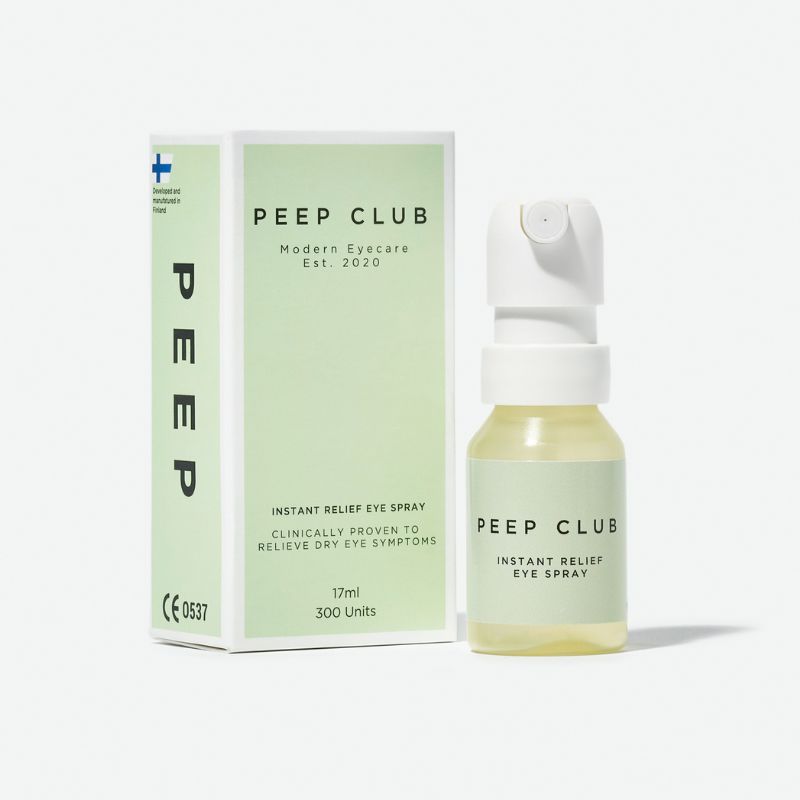
1. Peep Club Instant Relief Eye Spray — Best Overall for Sensitive Eyes
The Instant Relief Eye Spray was designed specifically for people whose eyes react to everything else. Developed by optometrist Nicola Alexander-Cross, it is preservative-free, fragrance-free, and alcohol-free — and unlike traditional drops, it’s a spray, so there’s no aiming, no blink reflex, and no mess.
The formula uses sodium hyaluronate for hydration alongside sea buckthorn oil. What makes it different from every other product on this list is that those ingredients also nourish the delicate skin around the eyes — something no traditional eye drop does. It is clinically studied to relieve dry eye symptoms, and like any good preservative-free lubricant, regular use can help reduce redness naturally over time by addressing the underlying dryness rather than masking it with blood vessel constrictors.
The spray format is a significant advantage for sensitive eyes. Instead of prying your eye open and trying to aim a drop (which triggers the blink reflex and often leads to missed doses or contamination), you simply spray it onto closed eyes. The solution absorbs through the eyelid margin and reaches the tear film without any of the discomfort of traditional application.
“So many people struggle with eye drops. They miss, they blink, or the drops run straight down their face. An eye spray removes all of that hassle. You simply spray it onto closed eyes and let it do the work. It’s one of the easiest ways to keep your eyes feeling comfortable throughout the day.”
— Nicola Alexander-Cross, BSc MCOptom, Optometrist & Founder of Peep Club
- Key ingredients: Sodium Hyaluronate, Sea Buckthorn Oil
- Pros: Preservative-free; spray-on format (no aiming, no blinking out); clinically studied; nourishes skin around eyes; works over contact lenses; no single-use vials; optometrist-developed
- Cons: Spray format may feel unfamiliar at first if you’re used to traditional drops
- Best for: Sensitive eyes that react to other drops; dry eyes from screen time; contact lens wearers; anyone who struggles with traditional drop application; daily use
Price: $25 — Shop Instant Relief Eye Spray
2. Systane Ultra Preservative Free — Best Widely Available Option

Systane Complete PF is one of the most popular preservative-free eye drops on the market. It uses propylene glycol as its active lubricant alongside mineral oil and phospholipids, giving it a milky appearance and a formula designed to address multiple layers of the tear film. It comes in a convenient multi-dose bottle rather than single-use vials.
It’s widely available in pharmacies and a solid choice for general dry eye relief. The multi-dose bottle is a real advantage over single-use vials for everyday convenience. The main downside for sensitive eyes: the inactive ingredients include emulsifiers (polyoxyl 40 stearate, sorbitan tristearate), and it still requires traditional drop application.
- Key ingredients: Propylene Glycol, Mineral Oil, Dimyristoyl Phosphatidylglycerol
- Pros: Preservative-free multi-dose bottle; widely available in pharmacies; addresses multiple layers of the tear film; well-known brand
- Cons: Contains emulsifiers; traditional drop application required (tilting, aiming, blinking); no benefit to skin around the eyes
- Best for: General dry eye relief; those who want a preservative-free multi-dose bottle from a trusted pharmacy brand
3. Refresh Optive Sensitive — Best for Mild Sensitivity

Refresh Optive Sensitive is specifically marketed for sensitive eyes and uses carboxymethylcellulose (CMC) as its active lubricant. It is preservative-free in single-use vials and has a relatively simple formulation compared to other options in the Refresh range.
The CMC formula provides good surface lubrication, though it primarily addresses aqueous (water) deficiency rather than the lipid layer of the tear film. The inactive ingredients are very clean — essentially just electrolytes and buffers. The single-use vials are the standard trade-off for preservative-free drops: sterile but wasteful and impractical for frequent daily use.
- Key ingredients: Carboxymethylcellulose Sodium, Glycerin
- Pros: Preservative-free; designed specifically for sensitive eyes; gentle CMC formula; very clean inactive ingredients
- Cons: Single-use vials; traditional drop application; does not address the lipid layer; no benefit to skin around the eyes
- Best for: Mild sensitivity; occasional use; those who want a familiar pharmacy brand labelled for sensitive eyes
4. TheraTears Dry Eye Therapy — Best for Tear Film Balance

TheraTears was one of the first brands to formulate around the natural electrolyte balance of healthy tears, and it remains a respected option. The formula uses sodium carboxymethylcellulose to lubricate and is designed to match the osmolarity (salt concentration) of your natural tear film, which can reduce the stinging that some people experience with other drops.
Important for sensitive eyes: TheraTears comes in both a standard multi-dose bottle and preservative-free single-use vials. The standard bottle contains preservatives. If you have sensitive eyes, you must specifically buy the preservative-free version — do not assume the one on the shelf is PF just because the brand has a gentle reputation. The PF version has very clean inactive ingredients — just electrolytes and buffers — making it a good option for sensitive eyes.
- Key ingredients: Sodium Carboxymethylcellulose
- Pros: Designed to match natural tear electrolyte balance; preservative-free vials available; well-researched; ophthalmologist recommended
- Cons: Must specifically choose the PF version (the standard bottle is preserved); single-use vials; traditional drop application; does not address the lipid layer
- Best for: Those whose sensitivity is partly driven by tear film imbalance; mild to moderate dry eyes
5. Visine Red Eye Total Comfort — What to Avoid

We are including Visine Red Eye Total Comfort on this list not as a recommendation, but as a warning. This is the type of product that people with sensitive eyes reach for most often — and it is the type that causes the most harm.
Visine Red Eye contains tetrahydrozoline, a decongestant that works by constricting the blood vessels on the surface of your eye. Your eyes look whiter within minutes — but the effect is temporary. With regular use, the blood vessels adapt by dilating wider when the drops wear off, creating a cycle of rebound redness that makes your eyes look worse than they did before you started. This is called secondary hyperemia, and it is well-documented.
Worse still, the formula contains benzalkonium chloride (BAK) — the most damaging preservative commonly found in eye drops. BAK has been shown repeatedly to cause inflammation, disrupt the tear film, and damage the corneal epithelium with repeated use. For anyone with sensitive eyes, this combination of a vasoconstrictor and a toxic preservative is the worst possible choice.
“Drops sold as ‘whitening’ or ‘brightening’ contain an ingredient that temporarily constricts the blood vessels in the white part of your eyes. By causing the blood vessel to shrink your eyes appear less red. The main ingredient in these type of cosmetic drops is a type of decongestant (similar to the oral medication you would take if you had nasal congestion) — such as phenylephrine. These drops are only tackling the appearance of the redness — not the cause of the redness itself; which can be due to allergies, fatigue and in most cases, dry or tired eyes.”
— Nicola Alexander-Cross, BSc MCOptom, Optometrist & Founder of Peep Club
- Key ingredients: Tetrahydrozoline HCl (vasoconstrictor)
- Pros: Immediate cosmetic whitening effect (temporary)
- Cons: Contains benzalkonium chloride (BAK); causes rebound redness with regular use; does not address dryness or the underlying cause of redness; not suitable for sensitive eyes
- Best for: Not recommended for sensitive eyes under any circumstances
6. Rohto Cool Relief — Another One to Avoid

Like Visine, Rohto Cool Relief is on this list as a warning, not a recommendation. It’s a popular choice because the menthol gives an immediate cooling sensation that feels like the drops are “working.” But feeling is not the same as helping.
Rohto Cool Relief contains naphazoline — a vasoconstrictor that, like the tetrahydrozoline in Visine, constricts blood vessels to make your eyes look whiter temporarily. Same ingredient category, same rebound redness problem. It also contains benzalkonium chloride (BAK), alcohol, and menthol — a combination that is especially harsh on sensitive eyes. If Visine is the product most people know to avoid, Rohto Cool Relief is the one they don’t.
- Key ingredients: Naphazoline HCl (vasoconstrictor), Polysorbate 80
- Pros: Immediate cooling sensation; widely available
- Cons: Contains BAK (preservative); contains naphazoline (causes rebound redness); contains alcohol and menthol; does not address dryness; not suitable for sensitive eyes
- Best for: Not recommended for sensitive eyes under any circumstances
The Truth About Redness Relief Drops
Redness relief drops are one of the most misunderstood product categories in eye care. They are among the best-selling eye drops in pharmacies, and they are among the worst things you can put in sensitive eyes.
Here is how they work: redness relief drops contain a vasoconstrictor — an ingredient like tetrahydrozoline, naphazoline, or phenylephrine — that forces the blood vessels on the surface of your eye to shrink. Your eyes look whiter almost immediately. The effect lasts a few hours, and then the blood vessels return to their normal size — or, with repeated use, they dilate wider than before in a rebound effect.
This rebound redness (the clinical term is secondary hyperemia) creates a vicious cycle. You use the drops because your eyes are red. The drops make the redness temporarily disappear. When they wear off, the redness is worse. So you use more drops. Over time, the drops become less effective and the baseline redness gets worse.
“Many patients, especially those in office jobs, report that they love the whitening effect so much they rely on the drops daily — and who can blame them, we’d all like the eyes of someone who’s slept 9 hours a night. But that kind of use is certainly unhealthy for two reasons; first these drops contain preservatives that have been clinically proven time and again to cause long-term irritation and dryness to the eye — inviting with it increased sensitivity and allergies. Second, these specific drops can cause ‘secondary hyperemia’ or ‘rebound redness’ which means that the blood vessels rebel from being constricted so often and end up looking redder than they did before using the drops and rendering the drops themselves ineffective at relieving this worse appearance.”
— Nicola Alexander-Cross, BSc MCOptom, Optometrist & Founder of Peep Club
On top of the rebound effect, most redness relief drops also contain preservatives — typically benzalkonium chloride — that compound the damage. So you get the double hit: a vasoconstrictor that disrupts normal blood flow and a preservative that inflames and dries out the very surface you are trying to soothe.
The alternative is to address the cause of the redness rather than masking it. In most cases, red eyes are caused by dryness, screen fatigue, allergies, or a combination of these. A preservative-free lubricant — especially one that supports the lipid layer of the tear film, like the Peep Club Instant Relief Eye Spray — will reduce the appearance of redness over time by keeping the eye surface healthy and hydrated, without any of the risks of vasoconstrictors.
“Speak to your local optometrist about the underlying cause of your lingering redness — they should be able to differentiate between if it is an allergy, dry eyes, screen fatigue or possibly something that actually needs more attention like a bacterial or viral infection. There are other eye drops that can cause your eyes to be whiter and brighter, by tackling the source of the redness itself, rather than just the appearance. A good preservative-free dry eye drop or spray (like our Instant Relief Eye Spray) will reduce the appearance of redness while also helping protect the eye itself and improving eye comfort — an all-round win.”
— Nicola Alexander-Cross, BSc MCOptom, Optometrist & Founder of Peep Club
Why Sensitive Eyes Need More Than Just Preservative Free
Most people looking for eye drops for sensitive eyes start with “preservative free” as their main filter. That is a good starting point — preservatives are the single biggest cause of drop-related irritation — but it is not enough.
The TFOS DEWS II study, one of the most comprehensive reviews of dry eye science ever conducted, identified over 200 ingredients that are known to irritate the eye surface. These fall into seven broad categories:
- Preservatives — benzalkonium chloride, chlorobutanol, sodium perborate, and others
- Emulsifiers — polysorbates, cremophor, and similar surfactants found in many “preservative-free” drops
- Fragrances — unnecessary in any eye product and a common trigger for allergic reactions
- Alcohol-based solvents — ethanol, isopropyl alcohol, and related compounds
- Waxes and fillers — used to modify texture but can leave residue on the eye surface
- Tea tree oil and derivatives — sometimes included for lid hygiene but a known sensitiser
- Phosphate buffers — used to adjust pH but can cause calcium deposits on the cornea with frequent use
A drop can be preservative-free and still contain ingredients from several of these other categories. That is why many people switch to preservative-free drops and still experience stinging, redness, or general discomfort — the preservative was only one piece of the puzzle.
If you have sensitive eyes, preservative-free is the most important starting point. Beyond that, consider the ingredients that make a product do more than just lubricate — sodium hyaluronate and sea buckthorn oil can nourish the skin around the eyes as well as the tear film.
Frequently Asked Questions
What are the best eye drops for sensitive eyes?
The best eye drops for sensitive eyes are preservative-free. Good options include the Peep Club Instant Relief Eye Spray, Systane Complete PF, Refresh Optive Sensitive, and TheraTears PF. What sets the Eye Spray apart is the spray format (easier to use) and the sodium hyaluronate and sea buckthorn oil that also nourish the skin around the eyes — something traditional drops don’t do.
What are the best eye drops for allergies?
If your eyes are red, itchy, or watery due to allergies, you need two things: an antihistamine (which your doctor or pharmacist can recommend) and a gentle lubricant to keep the eye surface hydrated and flush out allergens. Avoid redness relief drops, which mask the appearance of allergy-related redness without treating it and can cause rebound redness. A preservative-free lubricant or spray used regularly will help keep the eye surface comfortable and supported through allergy season.
Are redness relief eye drops bad for your eyes?
Yes, with regular use. Redness relief drops contain vasoconstrictors that temporarily constrict blood vessels to make your eyes appear whiter. With repeated use, these cause secondary hyperemia (rebound redness) — the blood vessels dilate wider than before, making your eyes redder than they were before you started using the drops. Most redness relief drops also contain preservatives like benzalkonium chloride that damage the eye surface over time. They are not recommended for anyone, and especially not for people with sensitive eyes.
What are the best eye drops for contact lens wearers?
Contact lens wearers should look for preservative-free options, since preservatives can accumulate on the lens surface and cause irritation. The Peep Club Instant Relief Eye Spray can be used over contact lenses without removing them. For other products, always check the label to confirm they are safe for use with your specific type of contact lens — and avoid any drop containing benzalkonium chloride, which is known to cause problems with soft lenses.
Why do my eye drops sting when I put them in?
Stinging is most commonly caused by preservatives in the formula, but it can also be caused by emulsifiers, a pH that does not match your natural tears, or an already-compromised eye surface. If your eyes sting every time you use drops, switch to a preservative-free option — and if that still stings, look for one that is also free from emulsifiers and other known irritants. An eye spray applied to closed eyes can also eliminate the stinging associated with drops hitting the eye surface directly.
Can I use eye drops for dry eyes every day?
With preservative-free formulations, yes — most people use them 2 to 4 times daily. If you need relief more often than that, it is worth seeing an optometrist to investigate the underlying cause. Preserved drops should not be used frequently, as the cumulative preservative exposure can damage the eye surface over time and create a cycle where the drops themselves are contributing to the dryness.
What is the difference between eye drops and eye spray?
Eye drops are instilled directly into the open eye, which requires tilting the head back, aiming, and fighting the blink reflex. Eye sprays are applied to the closed eye and absorb through the eyelid margin. Sprays are generally easier to use, reduce waste from missed drops, and avoid the contamination risk of a bottle tip touching the eye. For people with sensitive eyes, the closed-eye application also avoids the direct impact of liquid hitting the eye surface.
How do I know if my eye redness is from dry eyes or something more serious?
Most everyday redness is caused by dryness, screen fatigue, or allergies and will improve with a good preservative-free lubricant and regular breaks from screens. However, if redness is accompanied by pain, discharge, sudden vision changes, or sensitivity to light, see an optometrist or doctor promptly — these can be signs of an infection or another condition that needs medical attention. Persistent redness that does not improve with lubricating drops also warrants a professional evaluation.
The Bottom Line
If you have sensitive eyes, the most important thing you can do is stop using products that irritate them — and that means looking beyond the “gentle” or “sensitive” label on the front of the box. Check the ingredient list. Avoid preservatives (especially benzalkonium chloride) and avoid redness relief drops entirely.
The Peep Club Instant Relief Eye Spray stands out for two reasons: its spray format eliminates the practical difficulties of traditional drops, and its formula nourishes the skin around the eyes as well as the tear film. If your eyes have reacted badly to every drop you have tried, it is worth trying something fundamentally different.
If your eye sensitivity persists or worsens, do not just keep switching products — see an optometrist. Sensitivity can be a sign of underlying dry eye disease, meibomian gland dysfunction, or other conditions that need proper diagnosis and treatment. For a deeper understanding of what causes dry eyes and how to manage them, read our Optometrist’s Guide to Dry Eyes.
Disclaimer: This article is for informational and educational purposes only and is not intended as medical advice. The information provided does not replace professional eye care consultation. Peep Club products are cosmetic and personal care products — they are not intended to diagnose, treat, cure, or prevent any disease. If you are experiencing persistent eye discomfort or changes in vision, please consult a qualified eye care professional.
